

When comparing bulk chemical suppliers, a higher quoted purity percentage can look like an easy way to identify the better offer. In practice, however, that number tells only part of the story. If two suppliers use different analytical methods, reporting bases, or product specifications, their results may not be directly comparable.
For procurement and quality control teams, evaluating Spermine Dihydrate requires a closer look at material identity, assay results, relevant impurities, water content, and batch documentation. Packaging, storage requirements, and the supplier's ability to maintain agreed specifications also matter when planning repeat purchases.
A structured evaluation helps buyers compare quotations on a consistent basis, prepare for incoming quality control, and identify documentation gaps before they delay an order.
This guide explains what to check when evaluating Spermine Dihydrate purity, how to interpret the supporting quality documents, and which questions to resolve with a supplier before committing to a bulk purchase.

2. Confirm the Identity and Form of Spermine Dihydrate
Before comparing analytical results, confirm that every supplier is quoting the same material. Chemical names, synonyms, and related compound names can cause confusion, particularly when different chemical forms are involved.
Essential Product Identifiers to Check
Start with the product information supplied by the manufacturer or distributor. The following details should be confirmed against the applicable product documentation:
Product name and accepted synonyms
CAS Registry Number
Molecular formula and molecular weight
Chemical form, including the hydrate designation
Grade and intended use, where specified
These details should be consistent across the product specification, quotation, COA, and product label wherever applicable. If information is missing or inconsistent, request clarification before placing the order.
Why Chemical Form Matters in Procurement
Spermine Dihydrate should not be confused with spermine in other chemical forms or with related polyamines such as spermidine. Although these compounds belong to the same broad chemical family, they have different molecular identities and should not be treated as interchangeable materials.
The hydrate designation is also important because it affects the material's defined composition and molecular weight. This can influence how buyers interpret specifications, compare analytical results, and calculate quantities.
When evaluating a quotation, confirm the exact compound and form rather than relying on a shortened product name or a general description such as “polyamine.”
If a supplier's identifiers do not align with the required material, resolve the discrepancy before proceeding to purity evaluation.
3. What Does Purity Mean for Spermine Dihydrate?
The term purity is often used broadly in supplier quotations, but different quality measurements describe different characteristics of a material. Understanding these distinctions helps buyers interpret analytical data without drawing conclusions from a single number.
Assay or Purity Percentage
Assay generally refers to the measured content of the specified substance according to a defined analytical method. The meaning of a reported percentage depends on the method, calculation basis, and specification.
For meaningful comparisons, buyers should establish whether the result is reported on an as-is, dry, or another defined basis. They should also check the analytical method and the applicable acceptance limit.
Two reported values should not be compared directly if the calculation bases or methods differ in ways that affect interpretation. A higher assay result does not, by itself, establish that a material has a better overall impurity profile or is more suitable for a particular application.
Water Content and Hydrate Form
Water content requires particular attention for a product specified as a dihydrate.
In a defined hydrate form, water is part of the compound's specified composition. Consequently, a measured water-content result must be interpreted in relation to the material's identity, the test method, and the applicable specification.
Buyers should not automatically classify all measured water as an unwanted impurity or assume that a lower water-content result is always preferable. Instead, confirm that the material's reported form and water-related results are consistent with the agreed requirements.
Impurities and Other Quality Attributes
Assay results do not necessarily describe every impurity present in a material. Depending on the product specification and manufacturing process, buyers may need to review related substances, residual solvents, inorganic residues, or other relevant quality attributes.
The appropriate impurity tests and limits should be established according to the material, intended application, and applicable quality requirements. Where additional assurance is needed, buyers can discuss further analytical information with the supplier.
Appearance and Application-Relevant Properties
Appearance and physical properties may also be included in a specification. Depending on the intended use, relevant parameters may include solubility or other characteristics associated with handling or downstream processing.
These checks can help identify deviations from the agreed specification, but appearance alone cannot establish chemical identity or purity.
Ultimately, Spermine Dihydrate quality should be evaluated against a defined set of criteria rather than a single percentage. There is no universal purity threshold that should be assumed to apply to every application or purchasing requirement.
4. Which Quality Tests Should Buyers Review?
Once the product identity and acceptance criteria are clear, buyers can review the analytical tests used to evaluate the material.
The appropriate test panel depends on the product specification, intended application, and relevant quality requirements. Not every test will be necessary for every purchasing scenario.
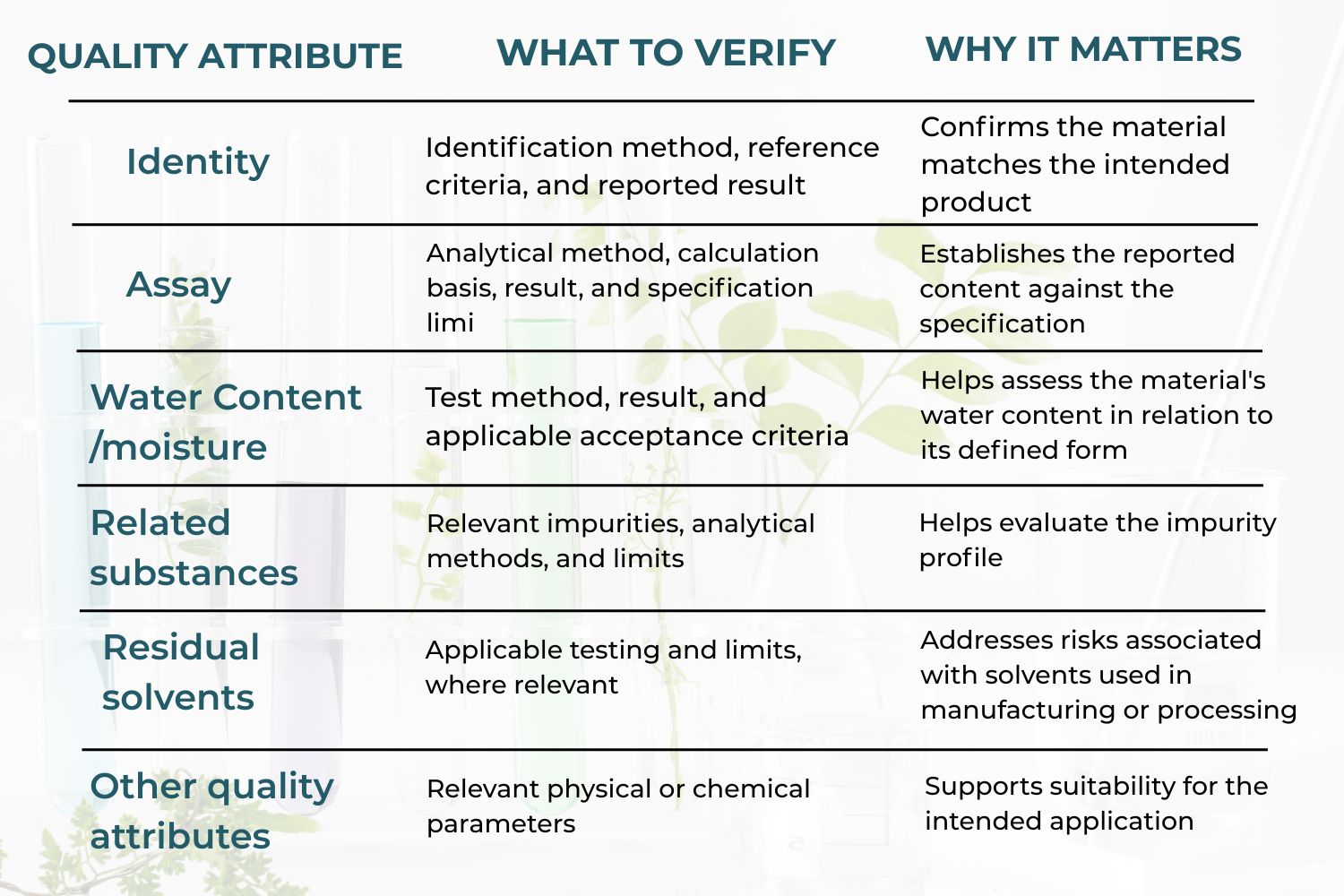
Identity testing helps establish that the material corresponds to the specified compound. Depending on the material and specification, suitable approaches may include spectroscopy, chromatography, or other appropriate analytical techniques.
Assay testing provides information about the measured content of the specified substance. Buyers should check the reported result against the applicable limit and confirm that the method and calculation basis are understood.
Water and impurity testing provide additional information that cannot necessarily be inferred from assay alone. For Spermine Dihydrate, water content should be interpreted in the context of the defined hydrate form, while impurity testing should reflect the established specification and relevant risks.
Where the purchasing risk or application warrants it, buyers may request analytical method references, validation summaries, or additional supporting data. Any further testing should be appropriate to the material and the buyer's quality requirements.
The objective is not to request the largest possible number of tests. It is to establish whether the available analytical evidence is sufficient to assess the material against the agreed specification.
5. How to Review a Spermine Dihydrate COA and Technical Documents
A Certificate of Analysis (COA) provides important information about a material's test results and its relationship to a defined specification. Before approving a purchase, buyers should assess both the content of the document and its relevance to the batch being supplied.
What to Check on the COA
A useful COA should identify the material and provide the information necessary to interpret the reported results. Depending on the supplier's documentation system, relevant details include:
- Product name and applicable identifiers
- Batch or lot number
- Test items and methods or method references
- Specification limits and actual results
- Units and calculation basis, where relevant
- Test or release date
- Authorized approval or release information
Buyers should establish whether the COA relates to the proposed commercial batch, a previously manufactured lot, or a representative sample. A sample COA may help demonstrate a supplier's reporting format, but it does not establish the test results of a different batch.
If an important test result, limit, or method reference is missing, request clarification before completing the quality review.
Which Supporting Documents Should Buyers Request?
In addition to the COA, other documents may be needed to support technical evaluation, safe handling, and purchasing approval.
The required document package depends on the buyer's application, internal procedures, and applicable requirements. Additional declarations should be requested when relevant rather than assumed to be universally necessary.
Check Consistency Across Documents
Product information should align across the COA, TDS, SDS, quotation, purchase order, and product label wherever relevant.
Pay particular attention to product identifiers, chemical form, specification limits, packaging configuration, and storage instructions. If documents conflict, resolve the discrepancy before the material is approved for use.
Agreeing on documentation requirements before shipment can help procurement and QC teams prepare for incoming inspection and reduce avoidable delays.
5. How to Review a Spermine Dihydrate COA and Technical Documents
A Certificate of Analysis (COA) provides important information about a material's test results and its relationship to a defined specification. Before approving a purchase, buyers should assess both the content of the document and its relevance to the batch being supplied.
What to Check on the COA
A useful COA should identify the material and provide the information necessary to interpret the reported results. Depending on the supplier's documentation system, relevant details include:
Product name and applicable identifiers
Batch or lot number
Test items and methods or method references
Specification limits and actual results
Units and calculation basis, where relevant
Test or release date
Authorized approval or release information
Buyers should establish whether the COA relates to the proposed commercial batch, a previously manufactured lot, or a representative sample. A sample COA may help demonstrate a supplier's reporting format, but it does not establish the test results of a different batch.
If an important test result, limit, or method reference is missing, request clarification before completing the quality review.
Which Supporting Documents Should Buyers Request?
In addition to the COA, other documents may be needed to support technical evaluation, safe handling, and purchasing approval.
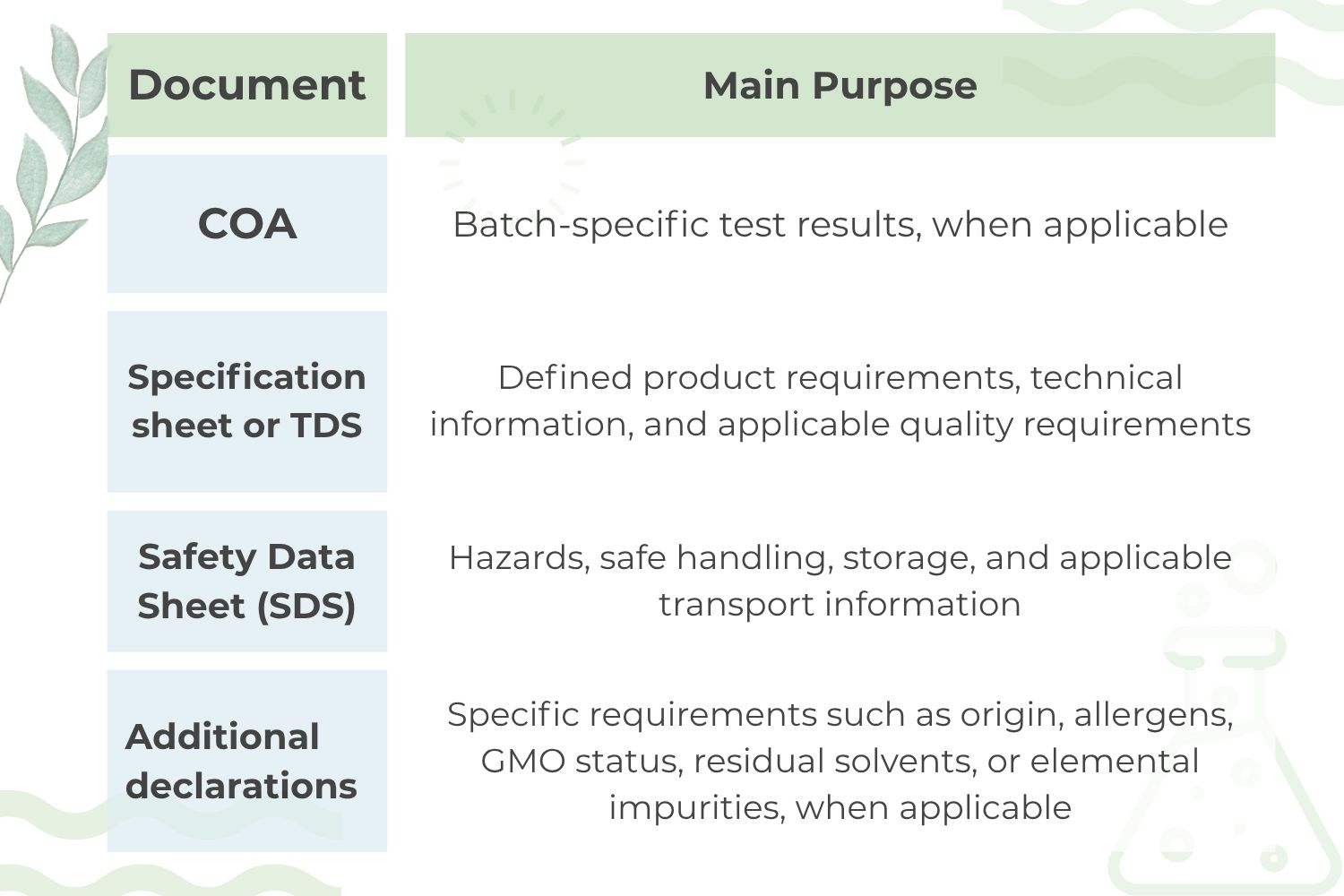
The required document package depends on the buyer's application, internal procedures, and applicable requirements. Additional declarations should be requested when relevant rather than assumed to be universally necessary.
Check Consistency Across Documents
Product information should align across the COA, TDS, SDS, quotation, purchase order, and product label wherever relevant.
Pay particular attention to product identifiers, chemical form, specification limits, packaging configuration, and storage instructions. If documents conflict, resolve the discrepancy before the material is approved for use.
Agreeing on documentation requirements before shipment can help procurement and QC teams prepare for incoming inspection and reduce avoidable delays.
6. Common Quality Risks in Bulk Spermine Dihydrate Purchasing
Even when a quotation appears competitive, several purchasing risks deserve attention.
Incorrect chemical form: Similar names or incomplete identifiers can lead to the wrong material being ordered.
Incompatible assay comparisons: Different methods, specifications, or reporting bases can make supplier results difficult to compare.
Untraceable documentation: A generic COA may not establish the quality results of the batch being purchased.
Overlooked packaging and storage requirements: Inadequate attention to packaging integrity, labeling, and recommended storage conditions can complicate receiving and handling.
Unverified batch consistency: A satisfactory sample does not prove that all future production lots will meet the same requirements.
Incomplete documentation before delivery: Missing records can delay incoming QC and material release.
These risks are best addressed before the order is placed. Buyers should define acceptance criteria, agree on the required documentation, establish sampling and inspection arrangements, and clarify how discrepancies or relevant changes will be handled.
7. How to Evaluate a Spermine Dihydrate Supplier
A supplier's suitability depends on more than price and quoted purity. Buyers should also assess the supplier's ability to meet technical requirements and support the purchasing process.
Product traceability and documentation. Confirm whether the supplier can provide relevant product specifications and batch documentation, and establish how the supplied material will be identified.
Analytical transparency. Ask whether the supplier can explain the applicable test methods, specification limits, and reported results. Unclear analytical information should be resolved before approval.
Quality management and change communication. For repeat purchases, discuss how deviations, nonconformances, and relevant changes affecting agreed requirements will be communicated and addressed.
Packaging and logistics. Confirm available packaging configurations, labeling, storage recommendations, shipment arrangements, and documentation timing.
Supply planning. Discuss order quantities, availability, lead times, and the process for coordinating repeat orders. Clear communication helps buyers plan inventory and avoid unnecessary delays.
Technical responsiveness. Evaluate whether the supplier can respond to procurement and QC questions with relevant information and documentation.
For qualified inquiries, Myland Pharm can discuss Spermine Dihydrate specifications, applicable product documentation, packaging options, and bulk-order requirements, subject to confirmation for the specific product and order.

Frequently Asked Questions About Spermine Dihydrate Bulk Orders
1. What is the delivery time for Spermine Dihydrate?
Generally, orders are shipped within 1–5 days after receipt of payment. Actual delivery schedules may vary depending on order requirements and shipping arrangements. Please contact Myland Pharm to confirm the lead time for your order.
2. Is assay the same as overall product quality?
No. Assay measures the content of the specified substance according to a defined method and reporting basis. Overall quality may also depend on identity, relevant impurities, water content, physical properties, and compliance with the applicable specification. A high assay result alone does not establish suitability for every application.
3. Can I request a Spermine Dihydrate sample before placing a bulk order?
Yes, samples are available upon request. Please contact Myland Pharm for details about sample availability and arrangements. If you have specific evaluation requirements, you can also discuss them with our team before proceeding with a bulk purchase.
4. Can Myland Pharm accommodate customized requirements or product specifications?
Yes. We can discuss customization requests and specific customer requirements. Please share your target specifications, packaging preferences, and other relevant requirements so our team can assess feasibility and confirm the available options.
5. What packaging options are available for Spermine Dihydrate?
Our standard packaging options are 1 kg per bag and 25 kg per barrel. Customized packaging may also be available according to your specific requirements. Please contact our team to discuss your preferred packaging format and order quantity.
Technical Disclaimer
The information provided in this article is for general informational purposes only and is intended to support technical evaluation and procurement planning. Product specifications, analytical methods, and acceptance criteria may vary according to the material, grade, and intended application. Buyers should review the applicable product documentation and conduct appropriate quality assessments before purchase or use. Please contact Myland Pharm for product-specific information and documentation relevant to your requirements.
Post time: Oct-19-2026


